Building systems monitoring for maintenance
A centralised Optimo IoT system for monitoring the building systems across several school buildings, improving maintenance and managing documentation and maintenance records in the cloud
Hardware: system architecture
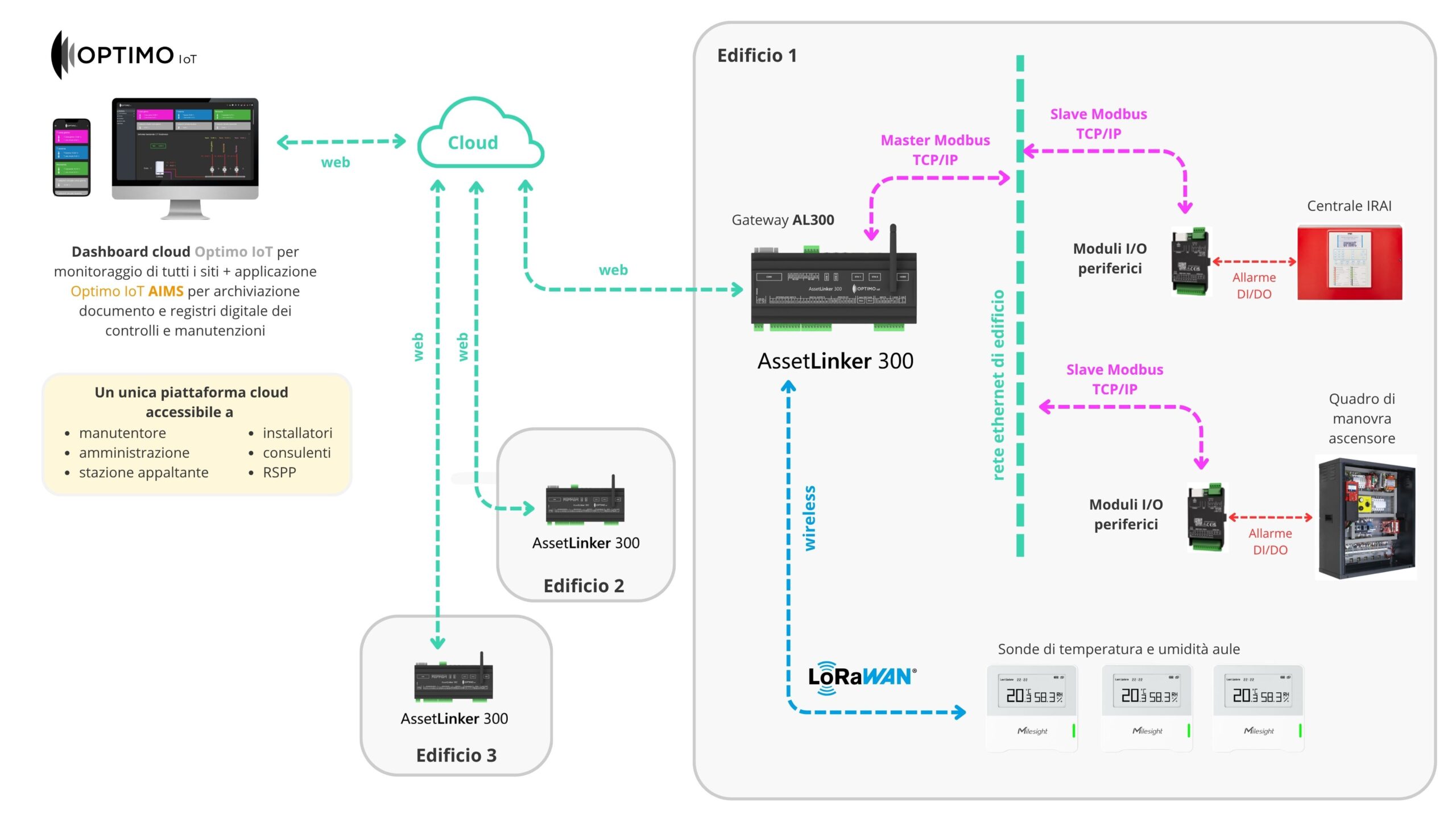
The setup uses Modbus I/O devices to collect data at the plant and send it to the AL300 gateway over the school’s Ethernet network, or wirelessly over LoRaWAN where no local network is available
- Optimo IoT AL300 gateway: The central device that gathers states and alarms from the monitored equipment and sends them to the Optimo IoT cloud monitoring platform. The AL300 gateway is extremely flexible and leaves room for new devices to be added later (further I/O modules, LoRaWAN wireless probes, photovoltaic inverters, and so on)
- Peripheral modules and probes: Peripheral modules communicating over Modbus TCP/IP, fitted at the plant itself, which collect the data (states and alarms, temperatures, analogue or digital measurements, and so on) and pass it to the AL300 gateway, which acts as the concentrator.
- Flexible connectivity: The peripheral modules talk to the AL300 gateway over Modbus TCP/IP on the Ethernet network. Where no network is available, the data can also be sent wirelessly using the long-range LoRaWAN protocol.
- Systems monitored: thanks to the peripheral modules and the AL300 gateway’s ability to integrate with other equipment, data coming from the building systems can be monitored remotely, for example:
- IRAI fire detection and alarm panels: data can be read over Modbus, or aggregated states and alarms can be picked up through the panel’s onboard I/O or through optional expansion modules. Alarm monitoring with the AL300 gateway is for supervision only and is not a safety function.
- Fire-fighting pressurisation sets: the general alarms of the fire pressurisation units can be collected, so faults or anomalies are picked up promptly
- Lifting equipment: the peripheral I/O modules can collect states and alarms from the control panels of passenger and goods lifts
- heating plants: the digital and analogue I/O modules can collect states and alarms from boilers, heat pumps, chillers and plant circulation pumps. The analogue I/O modules can read the working temperatures of the circuits, so every parameter of the heating plant is covered.
- energy monitoring: the electricity consumption of heat pumps and other electrical loads can be tracked with electricity meters, or with LoRaWAN wireless current sensors, which give you the load profile straight away with no invasive work
- Environmental parameters monitored: wireless sensors transmitting over LoRaWAN make it simple to monitor the building’s environmental parameters without invasive work, which matters especially in existing buildings:
- monitoring of temperature and humidity in the rooms: battery-powered probes let you map room temperature and indoor humidity
- monitoring of air quality: a probe can track the level of VOCs (volatile organic compounds) and CO2 in rooms such as classrooms or crowded assembly halls
- Occupancy sensors. occupancy sensors let you see how the rooms are being used
- sensors for light level: these track the illuminance in lux inside the rooms
The standard Optimo IoT way of working, to get the system running as quickly as possible
- Preliminary design work: the groundwork before the system is built, reviewing the plant through a site visit or a call with the maintenance provider
- Supply of the Optimo IoT remote monitoring system the monitoring equipment (AL300 gateway, sensors and so on) is supplied already programmed and configured, ready for your own maintenance provider or electrician to install
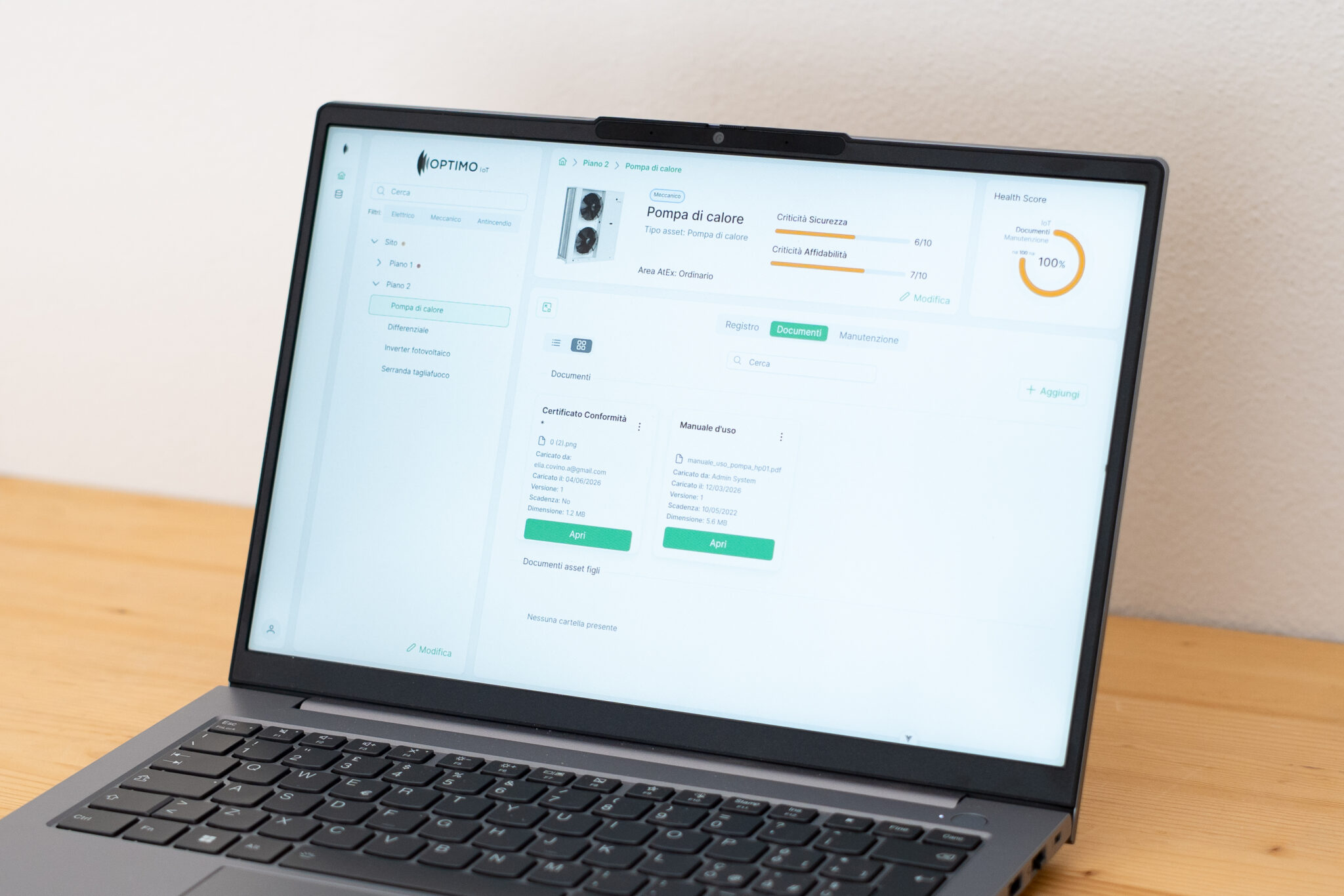
- Supply of the Optimo IoT AIMS document management system alongside the monitoring dashboards you can also use our new Optimo IoT AIMS application, which stores the plant documentation and keeps a digital logbook of inspections and maintenance, with multi-user access so everyone involved can get in (maintenance provider, contracting authority, building manager, consultants, operators, and so on).
- System commissioning: carried out on site or remotely, to commission and functionally test the monitoring system
Software: user interface and Web App
The data is sent to a cloud page reachable on the web from any computer. The interface gives you advanced tools for keeping things under control.
- Multi-site dashboards: A single cloud interface covers all six school buildings at once. The dashboards can be edited freely by the user.
- Multi-user management: Different user profiles can be created, each with its own level of access. This makes it easier for everyone involved to work together.
- Alarms and notifications: The system raises email and SMS warnings when something is wrong, triggered when user-defined thresholds are crossed.
- Reporting and API: The platform generates automatic reports sent out periodically by email, and can also connect to external platforms through an API.
- AIMS platform: This module handles digital storage of the plant documentation and keeps the inspection and maintenance logbook available at all times.
FAQs
Any system with a communication interface (Modbus or BACnet) or with dry contact digital outputs for states or alarms can be monitored.
Yes, but only if the panel has a Modbus communication interface or digital outputs carrying the alarm state. On any panel it is always possible to add optional modules to bring out the alarm signals for our gateway to read. Tell us the model of your panel and we will check whether it can be done.
Physical installation is not part of the Optimo IoT offer. It should be carried out by the client’s own installer, following the specifications Optimo IoT provides.
This is handled through the AIMS cloud platform, which stores the documents and keeps a shared digital maintenance logbook.
Yes. The AL300 gateway lets you add new devices over time. Monitoring for electrical loads, air conditioning or meters can be added easily.

Optimo IoT s.r.l.
via Francesco Restelli, 3
20124 Milan (MI) Italy
VAT no. 03834900130
Call us on +39 039 596 9780
Operational office: via Sant’Anna, 16 – 23875 Osnago (LC), Italy
Want to report a security issue? Get in touch